
New to cricket? Start here.
Everything you need to follow a match — from the very first ball to how the winner is decided. Five-minute read, no jargon assumed.
1The big idea
Cricket is a bat-and-ball game between two teams. One team bats and tries to score as many runs as possible. The other team bowls and fields and tries to stop them — by limiting runs and getting batters out.
Then the teams swap. Whoever scores more runs wins. That's it — everything else is detail.
2Two teams of eleven
- Each team has 11 players, led by a captain who sets the field and chooses the bowlers.
- When batting, only two batters are on the field at a time — one at each end of the pitch. The rest wait their turn.
- When fielding, all 11 are out there: one bowler, one wicketkeeper behind the stumps, and nine fielders.
- Players are usually known for a speciality — batters, bowlers, all-rounders (good at both) and the wicketkeeper.
- Two umpires on the field make the decisions.
3The field and the pitch
The game is played on a large, roughly oval grass field with a boundary rope around the edge. In the middle is the pitch — a 22-yard (20.12 m) strip of firm, short grass.
At each end of the pitch stands a wicket: three wooden stumps with two small bails balanced on top. The bowler tries to hit it; the batter defends it.
Want to see it? Open the Cricket Simulator to look around a full 3D ground.
4Balls and overs
- The bowler runs in and delivers the ball overarm at the batter, usually bouncing it once on the pitch first.
- Six legal deliveries make an over. After each over, a different bowler bowls from the other end.
- No bowler can bowl two overs in a row, and in limited-overs games each bowler has a maximum quota (for example, 4 overs each in a T20).
- Games are often described by how many overs each team gets — that's what "T20" or "50-over" means.
5What is an innings?
An innings is one team's turn to bat. It ends when either:
- 10 batters are out ("all out" — the last batter has no partner left), or
- the team has used all its overs (in limited-overs cricket), or
- the captain declares — chooses to stop batting early (Test cricket only).
Before the game the captains toss a coin; the winner chooses whether to bat or bowl first. The team batting first sets a total. The second team then chases it — they need one more run than the target to win.
In limited-overs games each team has one innings. In Test cricket each team has two.
6How runs are scored
- Running: after hitting the ball, both batters run to the opposite end. Each completed swap is one run. They can run 1, 2, 3 or more.
- Four: the ball reaches the boundary after touching the ground — 4 runs, no running needed.
- Six: the ball clears the boundary without bouncing — 6 runs.
- Extras: runs given away by the fielding side, such as a wide (too far from the batter to hit) or a no-ball (an illegal delivery, often overstepping the line). These add a run and the ball must be bowled again.
7Getting out
A batter who is out (a wicket falls) leaves and the next batter comes in. The most common ways:
- Bowled — the ball hits the stumps and knocks a bail off.
- Caught — a fielder catches the ball off the bat before it bounces.
- LBW (leg before wicket) — the ball would have hit the stumps but hit the batter's leg/pad instead.
- Run out — fielders break the wicket while a batter is still running between the ends.
- Stumped — the keeper breaks the wicket while the batter has stepped out of their ground.
A score like "145 for 6" (or 145/6) means 145 runs scored with 6 wickets lost.
8The formats
| Format | Overs per team | Innings | Length |
|---|---|---|---|
| T20 | 20 | 1 each | About 3 hours. Fast, big-hitting — the most popular format to watch. |
| 40-over | 40 | 1 each | Common in club, school and junior cricket — a half-day or most of a day. |
| ODI / One-Day | 50 | 1 each | A full day (around 7–8 hours). "ODI" = One Day International. |
| Test match | No limit | 2 each | Up to 5 days. At least 90 overs are scheduled each day (in total, not per team). The ultimate test of skill and stamina. |
Grassroots and junior cricket also use shorter modified formats with softer balls and smaller fields so everyone gets a bat and a bowl.
9How is the winner decided?
- Won by runs — the team batting first defends its total. E.g. 180 vs 165: "won by 15 runs".
- Won by wickets — the chasing team passes the target before losing all its wickets. E.g. reaching the target with 3 batters out: "won by 7 wickets".
- Tie — both teams finish on exactly the same score. In T20s a Super Over (one over each) is often used to break the tie.
- Draw — Test matches only. If time runs out before one side can bowl the other out twice and pass their total, the match is drawn — no winner.
- No result — the game is abandoned (usually rain) before enough play has happened.
- Rain-shortened games — in limited-overs cricket, the DLS method (Duckworth–Lewis–Stern) recalculates a fair target when overs are lost.
10Words you'll hear
- Duck — out for zero. Golden duck — out first ball.
- Century / fifty — 100 / 50 runs by one batter.
- Maiden — an over with no runs scored off the bat.
- Hat-trick — a bowler taking wickets with three balls in a row.
- Run rate — average runs per over. Required rate — what the chasing team needs.
- Partnership — runs added by the two batters currently together.
- Powerplay — opening overs in limited-overs games with fielding restrictions, so batters attack.
Ready for more? Pick a topic on the left — Fielding and Laws & field are good next stops.
1The four levels
Every cricket nation names things differently, but the ladder is the same shape everywhere:
- Club & grassroots — local clubs playing other clubs in a league or association. Juniors play in age groups; adults in grades, from social to the top club competition.
- Representative / pathway — the best club players are picked for district, regional, zone, state or county age-group teams.
- Domestic / first-class — professional state, county, provincial or franchise teams, in first-class, one-day and T20 competitions.
- International — the national team: Tests, ODIs and T20Is.
2What it's called where you are
| Country | Club & grassroots | Representative | Domestic | International |
|---|---|---|---|---|
| Australia | Woolworths Cricket Blast, junior & senior club cricket in local associations; Premier (grade) cricket at the top | "Rep" cricket — association & regional teams, state under-age championships | States: Sheffield Shield, One-Day Cup, Big Bash League | Australia |
| India | Gully & school cricket, club and maidan leagues | District teams, state age-groups (Vijay Merchant U16, Cooch Behar U19) | States: Ranji Trophy, Vijay Hazare, Syed Mushtaq Ali; IPL | India |
| England & Wales | All Stars & Dynamos, club leagues; ECB Premier Leagues at the top | County age-group squads (U11–U18) | 18 first-class counties: County Championship, Vitality Blast, One-Day Cup; The Hundred | England |
| South Africa | School & club cricket | Provincial age-group teams; Khaya Majola Week (U19 schools) | Professional domestic teams; SA20 | Proteas |
| Sri Lanka | School cricket ("Big Matches") & clubs | Provincial & age-group teams | Major clubs play first-class cricket; Lanka Premier League | Sri Lanka |
Competition names and sponsors change from season to season — your club or state/county association will have the current pathway for your area.
1A match, step by step
- The toss. Captains flip a coin; the winner chooses to bat or bowl first.
- Taking the field. All 11 fielders go out; the batting side sends 2 batters — the rest wait their turn.
- Striker and non-striker. The striker faces the bowler; the non-striker waits at the bowler's end, ready to run.
- Each ball, the striker can attack (play a shot), defend (block) or leave it (let it pass to the keeper).
- Runs. Both batters run to swap ends — 1 run per crossing. Odd runs mean they change who faces.
- Boundaries. Touches the ground before the rope: 4. Clears the rope on the full: 6.
- Extras. Wides, no-balls and byes add runs to the batting side's score.
- Wickets. Bowled, caught, LBW, run out, stumped — the next batter comes in.
- End of the over. After 6 legal balls a different bowler bowls from the other end.
- Innings break. After 10 wickets or the last over, the teams swap.
- The chase. The second team needs one more run than the first. Reach it: win by wickets. Fall short: lose by runs.
Scoring a junior match
Every junior game needs a manual scorer — often a parent. Pick your child's stage and follow the narrated walkthrough on the real scoresheet.
1Calls and signals at a glance
| Call | When | Signal | Legal ball? |
|---|---|---|---|
| Wide | Too wide to hit — outside the wide guide lines if your competition uses them. Runs taken off a wide are all wides. | Both arms out sideways | No — re-bowled |
| No-ball | No part of the front foot behind the popping crease; full toss above the waist; bounces more than twice or rolls; pitches off the pitch. | One arm out sideways | No — re-bowled |
| Free hit | Next ball after a no-ball — only if your stage's rules use free hits. | One arm raised, circled | — |
| Bye | Ball misses bat and body; batters run. | Open hand raised above the head | Yes |
| Leg bye | Ball hits the body (not bat or gloves) while playing a shot or evading; batters run. | Touch a raised knee | Yes |
| Short run | A batter turns without grounding bat or foot over the crease. | Fingertips to the nearest shoulder | — |
| Four / Six | Ball reaches the rope after bouncing / clears it on the full. | Arm across the chest / both arms up | Yes |
| Out | After an appeal, the batter is out. | Index finger raised | Yes |
| Revoke last signal | You signalled by mistake. | Hands crossed onto opposite shoulders | — |
Wide lines, free hits, powerplays and bouncer rules vary by competition and stage — check your association's playing conditions before the game.
Drills
Player pathway
What a player needs to learn at each level. Early on, skills matter most; mindset and fitness grow in importance as players move up.
Downloads
Printable Cricket Caddy guides and sheets — free to print and share with your team.
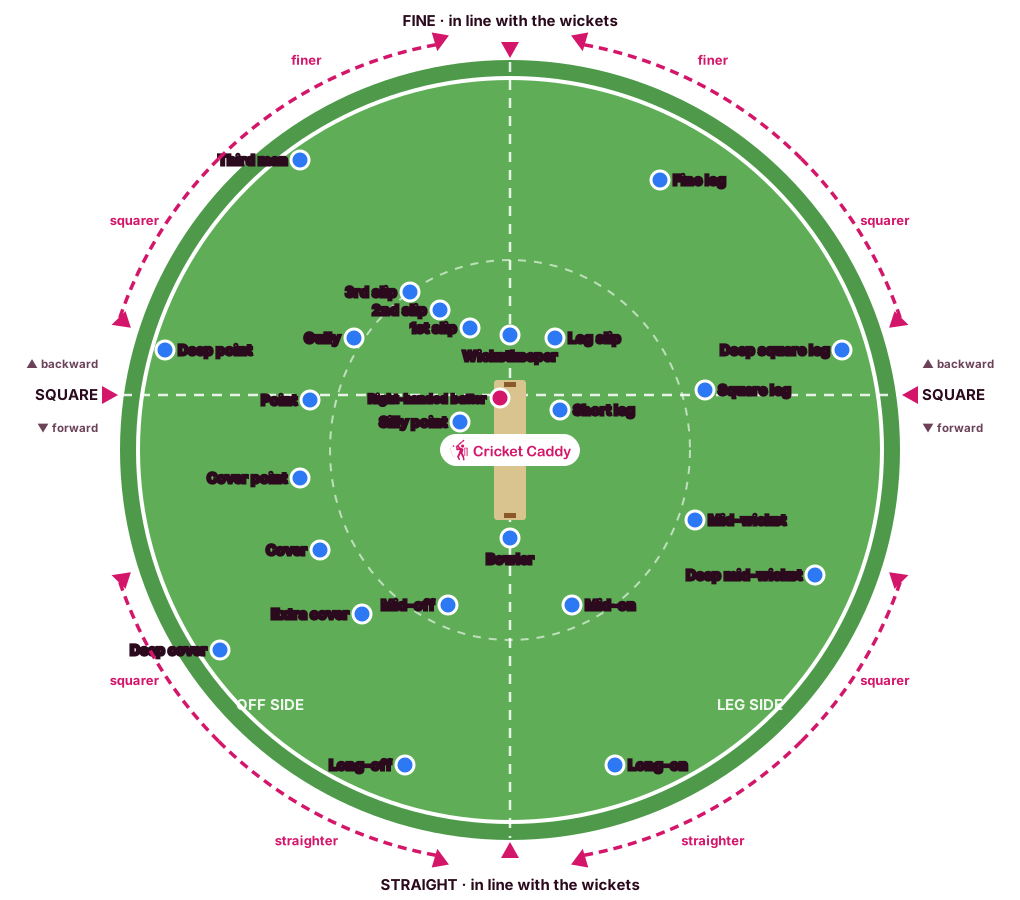
Fielding positions
Every standard position, seen from behind the bowler. "Deep" means near the boundary; "short" or "silly" means close to the batter.
DLS target calculator
When rain cuts overs from a limited-overs match, the Duckworth–Lewis–Stern (DLS) method sets a fair revised target. Enter the match details to estimate it.
How DLS works — the key ideas
- Runs come from two resources: overs and wickets. A team with 30 overs left and 9 wickets in hand can score far more than one with 30 overs and 2 wickets in hand. Simply scaling by overs ("run rate") ignores wickets — that's why the old average-run-rate method was unfair.
- Every situation has a "resources remaining" percentage. At the start of a 50-over innings a team has 100% of its resources. As overs are bowled and wickets fall, that drops — slowly at first, then faster as wickets go.
- Rain takes resources away. Losing 15 overs early with all wickets in hand costs a lot; losing the same overs when 8 wickets are down costs much less, because the team couldn't have used them fully anyway.
- The target is scaled by the ratio of resources. If Team 2 has less than Team 1 had, the target is Team 1's score × (Team 2 resources ÷ Team 1 resources), rounded down, plus one.
- If Team 2 has more resources (e.g. Team 1 was interrupted), the extra is converted to runs using an average first-innings score, G50 — 245 for top-level 50-over cricket, 200 at lower levels.
- Par score. If play can't resume, the side that's ahead of the "par score" for its wickets lost wins. The calculator shows this too.
- Stern's update (2014). Steven Stern refined the model for modern, higher-scoring cricket — the "S" in DLS. Professional matches use a computer version of the model; the Standard Edition uses published tables.
Read more: Duckworth–Lewis–Stern method (Wikipedia) · Duckworth & Lewis's original 1998 paper · ICC playing conditions
Estimate only. This uses a mathematical approximation of the published Standard Edition resource table, not the official DLS software — official match targets come from the match officials. Close results may differ by a run or two.
Turn knowledge into progress.
Coaches use Cricket Caddy to record audio and video feedback, track every session and keep players improving between lessons.
Sign up free Try the Cricket Simulator